
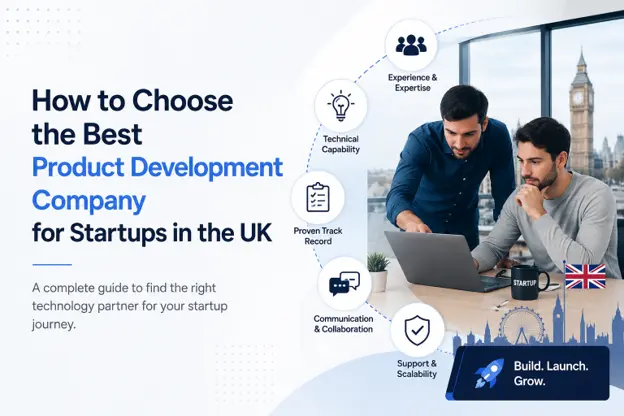
How to Choose the Best Product Development Company for Startups in the UK?
A product development company earns the right to work with a startup by running a genuine discovery phase before quoting a price, putting designers and engineers on one team instead of handing over a list of contractors, assigning full IP ownership of the code once it’s paid for, and pointing to named clients with checkable outcomes rather than a logo wall.
This guide features a researched shortlist of ten UK companies specialising in digital product development services, with direct answers on what a full build should include, how much it should cost, and how long it should take, based on verified data from Clutch, Google, Trustpilot, and each company’s published information as of mid-2026.
How Do You Evaluate a Digital Product Development Company?
Quality shows up before a single line of code is written. A provider worth hiring insists on a discovery phase, mapping user journeys, feature scope, and technical constraints, before it quotes a fixed number. A quote that skips this step is a guess wearing a plan’s clothing.
Six checks separate a genuine product partner from a ticket-taking dev shop:
- Cross-functional by default. Design, engineering, and QA sit under one roof. A provider that only supplies developers is quietly outsourcing product decisions back to the client.
- Verifiable proof, not a portfolio page. Look for reviews on an independent platform, such as Clutch, Google, or Trustpilot, with a visible review count, and case studies with specific numbers attached, rather than adjectives like “seamless” or “innovative.”
- Clean IP terms. The contract should say the code, designs, and documentation are assigned or transferred on payment, not merely licensed. A “perpetual non-exclusive licence” clause is a red flag, since it lets the agency reuse the build elsewhere.
- A named senior lead on delivery. Ask who actually writes the code, and who steps in if that person is unavailable. A structure resting on one freelancer is a single point of failure.
- A transparent pricing model. Fixed-price, time-and-materials, and outcome-based engagements carry different risk. A provider that can explain which model fits a given stage, and why, is more trustworthy than one pushing the same format on every client.
- A full handover on exit. Figma files, repositories, and documentation should belong to the client, not sit locked inside the agency’s own tooling.
The Best Product Development Companies for Startups in the UK
This list weighs UK presence, independently verifiable outcomes, and depth of service across the product lifecycle.
Two entries aren’t UK-headquartered despite appearing regularly in UK searches; that’s flagged directly rather than smoothed over, since accuracy matters more than a tidy list.
| # | Company | UK Presence | Best For |
|---|---|---|---|
| 1 | Bytes Technolab | Leicester studio | One partner for MVP build, AI integration, and long-term support |
| 2 | Vega IT | London office | A large dedicated team for regulated sectors |
| 3 | Unfold | Bristol, fully in-house | Published pricing and a small UK-only studio |
| 4 | Ronins | London & Surrey | Direct senior access over account managers |
| 5 | Cyber-Duck | London (CACI Group) | Accessibility- and compliance-led builds |
| 6 | Flying Age | Lviv, Ukraine (remote UK delivery) | Budget-conscious builds with strong UX |
| 7 | Thought&Function | UK-focused | Funding-stage-specific MVP builds |
| 8 | AND Digital | UK, Europe, US | Enterprise-scale delivery and upskilling |
| 9 | Successive Digital | Global, no dedicated UK office | Cloud- and AI-heavy engineering at global rates |
| 10 | Flipside Group | London (Weber Shandwick Collective) | Consumer brand strategy alongside engineering |
Top Digital Product Development Service Providers to Help UK Startups Scale (Detailed Review)
Every startup is at a different stage. Some founders are still testing whether their idea has real potential, while others are ready to build an MVP or improve an existing product. That’s why choosing the right product development company matters.
A good partner will provide the right mix of strategy, design, and development to help you move forward with confidence. Here are some of the companies startups trust to bring their ideas to life.
1. Bytes Technolab
- Headquarters: Leicester, UK
- Founded: 2011
- Core Services: Product Discovery, Product Development, POC Development, MVP Development, SaaS Development, AI & ML Development
- Best For: Startups, Scaleups, SMEs
- Ratings: Clutch 4.9/5 (46 reviews), Google 4.9/5, Trustpilot 4.4
Bytes Technolab is an AI-first digital product engineering partner with a UK studio in Leicester.
It works closely with startups and scale-ups, supporting the entire product lifecycle—from product discovery and proof-of-concept development to MVPs, SaaS applications, and front-end and back-end engineering.
The company also has deep expertise in AI technologies, including OpenAI, Agentic AI, and Gen AI, helping founders build AI-powered features into their products from day one rather than adding them later.
Founded in 2011, it’s one of the few names on this list carrying independently verified ratings on Clutch, Google, and Trustpilot at once, with consistently strong scores across all three.
The positioning is partnership-shaped: staying attached through MVP, iteration, and post-launch support rather than handing off a build and moving to the next client.
Best for: founders who want one partner covering MVP build, AI integration, and long-term support, without stitching together separate vendors for each.
2. Vega IT

- Location: 1 Cornhill, London EC3V 3ND
- In business: 18+ years
- Scale: 900+ engineers · 1,500+ projects delivered · 200+ clients
- Notable clients: UNICEF, UniCredit Bank, Costa Coffee, Howden
Vega IT runs three engagement models, time-and-materials, fixed-price, and outcome-based, so the commercial structure can match how well-defined the scope actually is.
Independent reviews consistently highlight technical depth and value for cost, with occasional notes about communication during busier stretches, a normal pattern at this scale rather than a red flag.
With more than 900 engineers and a client roster spanning UNICEF, UniCredit Bank, Costa Coffee, and Howden, the differentiator is scale: this is a provider built to supply a full dedicated product team, not a small studio.
Best for: funded startups or scale-ups needing a large, specialised engineering bench across regulated sectors like fintech or insurance.
3. Unfold

- Location: Bristol (fully in-house UK team)
- Ratings: Clutch 5.0/5
- Published pricing: £30,000 – £250,000
- Notable clients: Maeving, British Heart Foundation, BNGx
Unfold is unusual in publishing its own project cost range rather than routing every enquiry through a sales call first. It holds a 5-star Clutch rating and has built for electric motorbike brand Maeving, the British Heart Foundation, and regeneration platform BNGx.
The team says upfront when an off-the-shelf platform would genuinely serve a founder better than a custom build, a useful signal that the sales incentive isn’t always pointed at the biggest possible project.
Best for: founders who want a small, fully UK-based studio and value published pricing over a sales-call-only quote.
4. Ronins

- Location: London and Guildford, Surrey
- Scale: core team backed by a network of 200+ specialists
- Notable clients: the Kennel Club, Hitachi, Invictus Games
Ronins pairs a small senior team with a bench of roughly 200 specialists, brought in as projects demand, and positions itself as a partner rather than a supplier. Its case study with fishing platform
Catch reports the product growing to more than 3 million visits a year, with 35,000 new users added in a single off-season following a UX-led redesign. The firm says it will flag a mismatched brief before invoicing rather than after.
Best for: founders who want direct, ongoing access to senior strategists rather than being routed through account managers.
5. Cyber-Duck
- Location: London (part of the CACI Group)
- Certifications: ISO accredited · GOV.UK approved supplier · IAAP member
- Notable clients: Compare the Market, Worcester Bosch, Eurofighter, Cabot Financial
Cyber-Duck sits inside the CACI Group and holds ISO accreditation, GOV.UK approved-supplier status, and membership of the International Association of Accessibility Professionals.
Its product work spans public-sector and regulated-industry clients, including Compare the Market, Worcester Bosch, Eurofighter, and Cabot Financial, the last of which reports £40 million in transactions processed within four years of launch.
Accessibility and compliance are built into the process from the start rather than treated as a late-stage audit.
Best for: startups in healthcare, finance, or public-facing services where accessibility and compliance credentials need to exist from day one.
6. Flying Age
- Location: Lviv, Ukraine, not UK-headquartered, though it regularly serves UK clients remotely
- Ratings: Clutch 5.0/5 (30 reviews)
- Scale: 130+ projects delivered · 98%+ client satisfaction score
- Notable clients: Nova UA Federal Credit Union, AnalystPro
Flying Age is upfront about being based in Lviv rather than the UK, despite appearing regularly in UK agency searches.
It holds a 5-star Clutch rating across 30 reviews and reports a satisfaction score above 98% across more than 130 delivered projects, with a tech stack spanning TypeScript, Python, Flutter, and AI tooling including LangChain and TensorFlow.
Client work includes Nova UA Federal Credit Union and AI-native platforms such as AnalystPro.
Best for: budget-conscious founders comfortable working with a remote European team, particularly where UX and interface design carry real weight in the brief.
7. Thought&Function
- Location: UK-focused
- Ratings: Clutch 4.9/5, and named a top app development company for UK startups by Clutch
- Typical MVP build: 2–4 months
- Notable outcome: built health platform Doctorlink, which grew past 10 million UK users before its acquisition
Thought&Function organises its service around startup funding stages, with pre-seed, seed, and Series A each getting a distinct track, from MVP development through to team augmentation.
Its clearest outcome is health platform Doctorlink, which the firm helped grow to more than 10 million UK users before the platform was acquired. The firm quotes a typical two-to-four-month window for a first MVP.
Best for: very early-stage founders who want a provider structured around exactly where they are in the funding cycle.
8. AND Digital

- Location: UK, Europe, and US, organised into regional teams
- Scale: ~1,600 people across 25 “Clubs” of about 90 specialists each
- Model: Guide, Build, Equip
- Notable clients: British Airways, Lookers
AND Digital is a much larger consultancy than most names on this list, roughly 1,600 people organised into 25 “Clubs” of about 90 specialists each, running a model the firm calls Guide, Build, Equip, which pairs delivery with upskilling a client’s own team.
Client work includes British Airways and car retailer Lookers. This is enterprise-grade digital transformation capacity, priced and structured accordingly.
Best for: well-funded startups, corporate spinouts, or scale-ups needing enterprise delivery discipline; not typically the right fit for a pre-seed budget.
9. Successive Digital

- Location: no dedicated UK office evident in its public materials, despite appearing in UK-focused searches
- Focus: cloud, data, and AI engineering
- Client base: primarily US and India, spanning fintech, logistics, and e-commerce
Successive Digital is a global digital transformation company with a strong US and India client base and no dedicated UK office evident in its published materials.
Its published case studies lean heavily toward cloud, data, and AI engineering, and its product development services cover the full span from prototyping through MVP and ongoing iteration.
Best for: startups whose core need is heavy cloud, data, or AI engineering at global-delivery pricing, where a dedicated UK presence isn’t a requirement.
10. Flipside Group

- Location: 135 Bishopsgate, London EC2M 3AN
- Part of: the Weber Shandwick Collective
- Certifications: ISO 9001 and ISO 27001
- Notable clients: McDonald’s, Coca-Cola, Tesco, Uber, Tinder
Flipside Group sits inside the Weber Shandwick Collective, a global PR and marketing network, and holds ISO 9001 and ISO 27001 certification. Its client list leans toward household consumer brands, including McDonald’s, Coca-Cola, Tesco, Uber, and Tinder.
Being part of a marketing and brand network shows in how the firm frames product strategy alongside user research and prototyping, rather than treating engineering as a standalone function.
Best for: consumer-facing startups where brand strategy and go-to-market firepower matter as much as the engineering itself.
What’s Included in a Full Product Development Package?
A genuine full-lifecycle package covers six areas. A provider that quietly skips one is handing that risk back to the client.
- Discovery and product strategy: Defining the problem, validating demand, and scoping what actually needs building first.
- UX/UI design and prototyping: Clickable prototypes and interface design, tested with real users before engineering time is spent.
- Engineering: Front-end, back-end, and mobile development where relevant, plus the APIs and third-party integrations the product depends on.
- Quality assurance: Functional testing across devices and user roles, not just a pre-launch smoke test.
- Deployment and infrastructure: Cloud setup, CI/CD pipelines, and the DevOps work that decides whether releases are smooth or stressful.
- Post-launch support and iteration: Bug fixes, performance monitoring, and feature work driven by real usage data once the product is live.
Some providers add a seventh layer for AI-driven products: model integration, prompt or agent design, and MLOps to keep AI features reliable once they’re in production.
What Are the Typical Stages of a Product Development Project?
Nearly every provider reviewed above follows some version of the same five stages, which is useful because it gives a checklist to hold any proposal against.
- Discovery and research: Understanding users, market, and technical constraints before any design work starts.
- Design: Wireframes and prototypes that get tested and revised before development begins, catching mistakes on paper rather than in code.
- Build: The core engineering phase, usually run in short sprints with regular demos rather than one long build cycle.
- Testing and launch: QA across the key user journeys, followed by a controlled release rather than a single hard cutover.
- Iterate and scale: Using real usage data to refine the product, a phase that in practice never really ends for a product that’s working.
A proposal that jumps straight from brief to build, without a distinct discovery and design stage, is skipping the part of the digital product development process that catches expensive mistakes early.
What Technologies Do UK Product Development Companies Use?
Across the ten providers reviewed here, the same technology clusters show up repeatedly, a reasonable proxy for what a competent UK product team should have on hand in 2026.
- Front-end: React, Next.js, and Vue for web; React Native and Flutter for cross-platform mobile, which typically cuts the cost of native iOS-plus-Android builds by 25–40% compared with building both separately.
- Back-end:js, Python (often with Django), and .NET, chosen based on the team’s existing stack and the product’s performance needs.
- Cloud infrastructure: AWS, Microsoft Azure, and Google Cloud Platform, usually paired with Docker, Kubernetes, and infrastructure-as-code tools like Terraform.
- Data: PostgreSQL and MongoDB are the most common database choices, with Snowflake or BigQuery appearing on data-heavy products.
- AI and machine learning: OpenAI’s API, LangChain, TensorFlow, and PyTorch for teams building generative AI or predictive features directly into the product.
The specific stack matters less than whether a provider can explain why they’d choose one over another for a given product. A team defaulting to the same stack regardless of the brief is a weaker signal than one that asks about constraints first.
How Much Does Product Development Cost in the UK in 2026?
UK product development pricing in 2026 clusters into four fairly consistent bands, based on published agency rate cards and cost-benchmark data from sources including ITJobsWatch and Clutch.
| Stage | Typical UK cost | What it buys |
|---|---|---|
| Prototype / proof of concept | £2,000 – £20,000 | A clickable demo or validated concept, not working software |
| Lean MVP | £10,000 – £40,000 | A working product with core functionality, ready for real users |
| Standard MVP / mid-complexity build | £40,000 – £150,000 | Fuller feature set, integrations, and production-grade architecture |
| Enterprise-grade product | £150,000 – £500,000+ | Advanced security, compliance, multi-role access, and scale |
Day rates explain most of the spread between quotes for an identical brief. The median UK contract day rate for a software developer sits around £500, per ITJobsWatch, with senior specialists commanding £600–£900 in London and £350–£750 in regional UK cities.
Nearshore European teams typically bill £28–£60 an hour, and offshore teams £20–£40 an hour. None of these is automatically the wrong choice; they price different levels of oversight, time-zone overlap, and accountability, not just different code quality.
Three things founders routinely forget to budget for: UK agency quotes typically exclude VAT, so add 20%; post-launch hosting, monitoring, and support usually run 15–25% of the build cost per year; and some MVP development work qualifies for UK R&D tax relief, which is worth confirming with an accountant before the build starts.
Making Your Shortlist
Pull two or three names from the list above based on the “best for” line that matches the relevant stage and sector, ask each one to walk through their discovery process before they quote a number, and compare IP and handover terms as carefully as the price.
The cheapest quote and the right quote are rarely the same one, but a provider that can’t explain the gap between the two probably isn’t the one to build with.
Frequently Asked Questions
What is a product development company?
A product development company is a provider that covers the full lifecycle of building a digital product: discovery, design, engineering, testing, and post-launch support, rather than supplying developers alone and leaving product decisions to the client.
How much does it cost to hire a product development company in the UK?
Costs typically range from around £2,000 for a basic prototype to £500,000 or more for an enterprise-grade product, with most startup MVPs landing between £10,000 and £150,000 depending on scope and complexity.
How long does it take to build an MVP in the UK?
Most UK providers quote 8 to 16 weeks for a first MVP, though this depends heavily on scope. A well-run discovery phase before the quote is what makes that estimate reliable rather than optimistic.
Should a startup use a UK-based or offshore product development company?
UK-based teams offer easier time-zone overlap, stronger regulatory familiarity, and simpler accountability. Offshore and nearshore teams cost less per hour but usually need more oversight. Many startups land on a hybrid model: a UK-based lead managing an international delivery team.
What’s the difference between a product development company and a software development agency?
A software development agency typically executes a defined brief. A product development company gets involved earlier, shaping what should be built through discovery and UX work before any code is written, and usually stays involved after launch to iterate on real usage data.
Author Profile

- Blogger by Passion | Contributor to many Business Blogs in the United Kingdom | Fascinated to Write Blogs in Business & Startup Niches |
Latest entries
 BusinessAugust 17, 2026How to Choose the Best Product Development Company for Startups in the UK?
 SEOJune 26, 2026How Gaming Brands Build Trust With Content?
 BusinessJune 17, 2026Best Coworking Offices in Central London for Remote Workers
 BusinessJune 4, 2026Scotland’s SaaS Sector Has a Selling Problem