
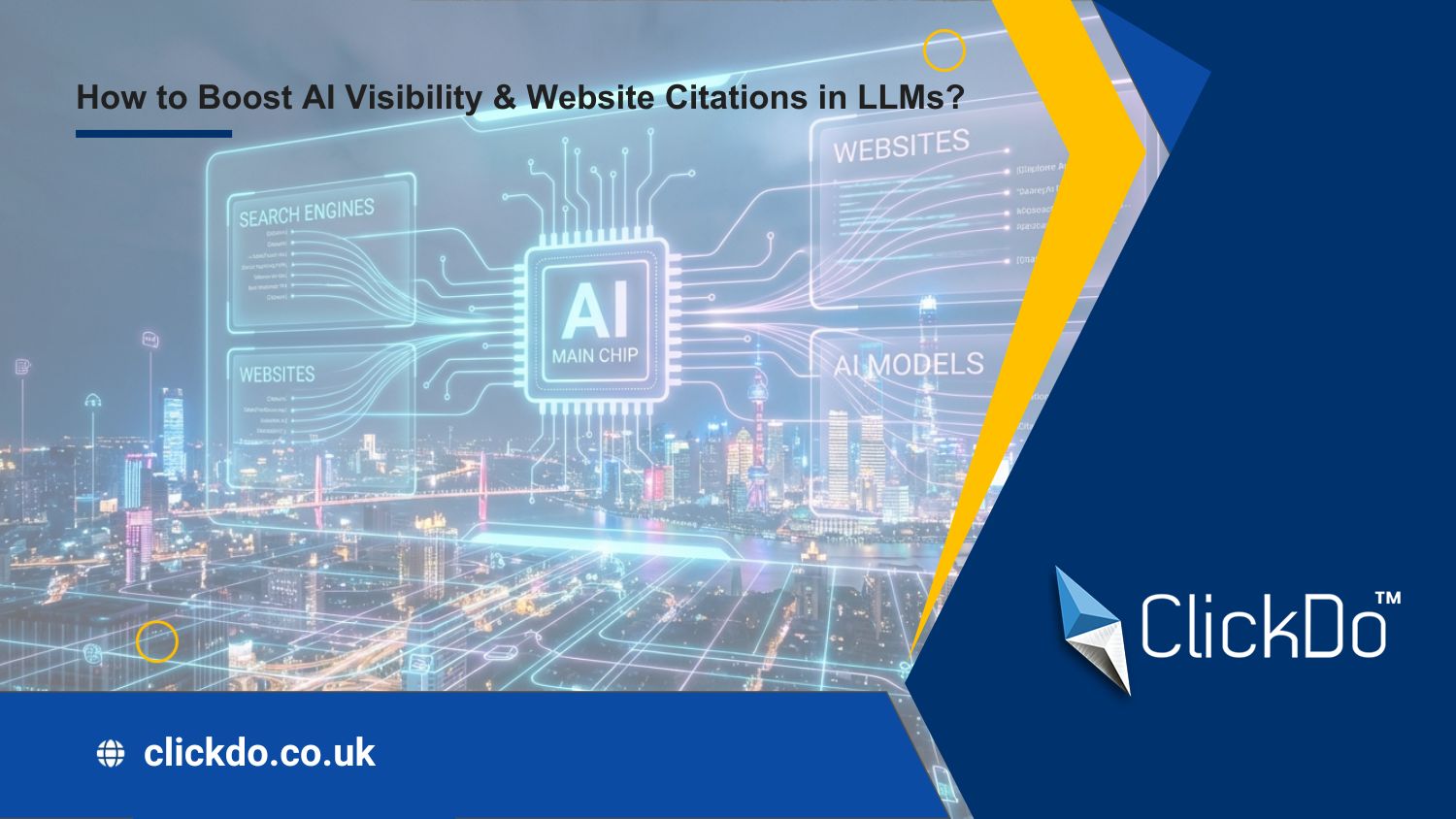
How to Boost AI Visibility & Website Citations in LLMs?

The ongoing move from Search Engine Optimization (SEO) to Generative Engine Optimization (GEO) and Answer Engine Optimization (AEO), impacts how brands approach digital visibility and we delve into this in more detail in our AEO vs SEO guide.
For marketing experts operating in highly competitive markets such as the UK, understanding the nuances of how these AI models select and cite sources is no longer an optional skill set but a core strategic requirement to prevent the “Invisibility Gap”—a phenomenon where brands rank at the top of Google but are completely omitted from AI-generated summaries.
While Google’s algorithm primarily seeks to direct users to external links, LLMs are designed to serve as “answers engines,” synthesizing vast amounts of data to provide direct, conversational responses.
This evolution has led to a dramatic rise in zero-click searches, where users satisfy their queries entirely within the AI interface. To remain relevant, brands must transition from being “on the list” to becoming “the answer”.
But that’s easier said than done so below we list some AI visibility boosting strategies making a difference, let’s go.
The Foundation of Visibility: AI Citation Tracking, Diagnostics & Top Strategies
The primary obstacle in optimizing for LLMs is the lack of traditional analytics. Standard SEO metrics like Click-Through Rate (CTR) and keyword ranking do not translate to generative environments where the success metric is the “Brand Mention Rate” or “Citation Frequency”.
This is where advanced technologies and tools like AI citation trackers and growth engines become indispensable for the modern marketing executive and we recommend reviewing and compare these for the best match.
The Role of AI Citation Growth Engines in GEO Strategy
 If you haven’t heard of AI citation growth engines yet, read on. A specialized generative engine optimization and marketing agent platform like Dageno AI for example, provides a closed-loop system for tracking how a brand is mentioned, cited, and recommended across various AI models like ChatGPT, Perplexity, Gemini, Claude, Grok, DeepSeek, Qwen, and Google AI. This technology moves beyond simple keyword tracking to analyse the “semantic reach” of a brand. It allows experts to identify visibility gaps—specific queries where a competitor is cited as the authority while the brand remains silent—enabling a targeted approach to content distribution and technical optimisation.
For an agency like ClickDo, the ability to demonstrate AI visibility ROI is a powerful differentiator. Tracking the “Brand Mention Rate”—the percentage of AI-generated responses to a specific prompt that include the brand name—provides a concrete baseline for progress in the generative search era. Furthermore, dageno.ai facilitates competitive monitoring, allowing businesses to benchmark their “Share of Voice” against rivals across the same prompts.
A citation tracking tool like Dageno AI also offers a full-chain diagnostic system from technical, content, AI extractability, brand entity, backlinks, to competitor analysis while it converts diagnostic insights into automated action, powering PLG and content-rich brands at scale. It builds AI citation authority at scale without having to manually produce a lot of new content by supporting automated internal linking with structured knowledge and multi-platform content, leading to rapid AI citation gains globally.
Equipped with the right tools, we can then move on to the key AI visibility boosting strategies outlined next.
Strategy 1: Structural Content Optimization for Modular Machine Extraction
AI models do not read content like human beings; they parse it into modular “chunks” or tokens to facilitate retrieval-augmented generation (RAG). To increase the likelihood of citation, content must be structured to favour this extraction process. A study of 1.2 million ChatGPT responses revealed a “ski ramp” pattern: 44.2% of citations originate from the first 30% of a document. This suggests that information density must be front-loaded.
The Answer Capsule Method
Marketing experts should implement “Answer Capsules”—concise, 40–60-word summaries placed immediately following a question-based heading (H2 or H3). This structure acts as a “direct signal” to AI crawlers that the content is a definitive answer to a specific user intent. When providing local SEO services, for example, a section titled “What is the ROI of Local SEO?” should lead with a clinical, data-backed summary before proceeding into narrative detail. Using proper nouns and full names repeatedly rather than unidentifiable fillers without context, makes the content more “citable”.
Strategy 2: Building an Online Presence Beyond the Own Domain
AI systems consistently prioritize citations from third-party platforms for comparative and evaluative queries. When a user asks, “Which is the best digital marketing service in London?”, the AI looks for a consensus across the web rather than relying on the brand’s own marketing copy.
Leveraging the “Kingmaker” Platforms
For many AI models, certain domains act as “kingmakers”—sources so authoritative that they serve as the default reference for entire industries.
- Reddit and Community Engagement: Reddit accounts for 46.7% of Perplexity’s top citations. For subjective and recommendation-based queries, authentic participation in subreddits is critical. Comments that offer genuine value and expert insights can be indexed and cited as community-validated recommendations.
- YouTube and Video Transcripts: Approximately 14% of Perplexity’s citations come from YouTube. Because models process the transcripts of videos, a well-structured “How-To” video on link building can become a cited source for an AI’s response on the same topic.
- Review Platforms: Maintaining active profiles on G2, Yelp, Trustpilot and business directories like ukbusinesslist.co.uk increases the probability of being cited by ChatGPT by 3x for trust-based and comparative queries. These platforms provide the “validation layer” that AI models use to assess credibility.
- Digital PR and Expert-Led Coverage: Digital PR is no longer just about backlinks; it is about “entity validation”. Coverage in authoritative publications like Forbes or TechRadar but even niche publications like London Business News or Green Living Blog provides a massive boost to AI visibility because these are the primary sources used during the training phase of many LLMs.
Strategy 3: Implementing Advanced Schema for AEO
Schema markup acts as a machine-readable translation layer, clarifying entities and relationships for AI systems that struggle with the ambiguity of natural language. While standard schema is helpful for SEO, specific types are essential for AEO.
Key Schema for AI Visibility
- FAQ Page Schema: This is arguably the most powerful schema for AI citation, as it provides a direct map of question-answer pairs that RAG systems can lift verbatim.
- HowTo Schema: For businesses offering instructional content, such as a guide to starting a blog, HowTo schema ensures that the AI understands the sequence of steps, making it more likely to display the brand as the primary source for “how-to” queries.
- Article Schema with Author Attribution: AI models prioritize content with verifiable authorship. Linking an author to their credentials via Person schema and the sameAs property helps establish the “Expertise” component of E-E-A-T.
- Organization Schema: This reduces ambiguity in brand mentions. By linking a website to its social profiles and official listings, the AI can more easily associate the site with its broader digital footprint.
Strategy 4: Content Freshness and Trust
LLMs, especially those with real-time web access like Perplexity, exhibit a strong bias toward recent content for certain query types. Pricing, tool reviews, and industry policies are highly sensitive to “freshness signals” and factual density. Content that includes original data, verifiable statistics, and clear attributions to third-party sources is perceived as more definitive and “safer” for the model to repeat.
The Freshness & Evidence-Backed Retrieval Signal
Research indicates that content labelled as “updated two hours ago” can see a 38% increase in citation frequency on Perplexity compared to month-old content. However, this must be a “meaningful update.” Simply changing the date on a page is often insufficient; models look for a revision history, a changelog, or the addition of new, current data points. It is recommended that a claim, statistic, or data point be included every 150-200 words. This signal of authority is particularly critical for models like Claude, which are trained to avoid hallucinations by grounding their responses in high-accuracy data.
For a business in the UK, maintaining a quarterly or even monthly update cycle for “best of” lists or pricing guides is essential for sustained AI visibility.
Integrating the “CITABLE” Framework for UK Marketers
To synthesize these strategies into a repeatable workflow, marketing experts can adopt the CITABLE framework which has also been covered by above mentioned sources, which focuses on structuring content specifically for machine retrieval.
The CITABLE Framework Components
- C – Concise Entity Definitions (BLUF): Use the “Bottom Line Up Front” approach. Lead with the direct answer in the first 40-60 words to satisfy the retrieval system’s initial scan.
- I – Intent Architecture: Map every heading to a specific user question derived from sales data or “People Also Ask” boxes.
- T – Third-Party Validation: Cultivate mentions on Reddit, YouTube, and authority publications to create a consensus signal.
- A – Authoritative Density: Include verifiable facts and statistics every 150-200 words to signal expertise.
- B – Block-Structured Content: Design pages as modular, standalone chunks of 200-400 words to facilitate easy “lifting” by RAG systems.
- L – Logical Markup: Implement comprehensive schema and consider serving content in Markdown to simplify machine parsing.
- E – Evidence-Based Citations: Cite your own reputable sources and link to authoritative data to show the AI that your content is trustworthy.
The Referral Value of AI – The ROI of more AI Visibility?
 Users who click through from an AI citation have already been “pre-sold” by the model’s recommendation. These visitors demonstrate higher purchase intent and stronger conversion rates because the AI has acted as a trusted intermediary.
Furthermore, AI visibility has a brand-building effect that transcends the immediate click. Even if a user does not visit the site, seeing the brand cited as the authority on a topic increases brand recall and trust, which can lead to direct-branded searches later in the journey.
That’s why the evolution of search from a link-based system to an answer-based system represents the most significant challenge—and opportunity—for digital marketers in a generation. Success in this new era requires a blend of traditional SEO excellence and a new suite of GEO and AEO tactics, which we outlined above. However, without the right tools, any marketer will struggle to boost a brand’s AI visibility with a successful strategy that delivers sustainable ROI.
Author Profile

- As the Chief of Marketing at the digital marketing agency ClickDo Ltd I blog regularly about technology, education, lifestyle, business and many more topics.
Latest entries
 Digital MarketingSeptember 16, 2026From Google Rankings to AI Recommendations: What Birmingham Businesses Need
 Digital MarketingJuly 3, 20268 Best Niche Edit Services for SEO Agencies in 2026
 Search Engine OptimizationApril 13, 2026How to Boost AI Visibility & Website Citations in LLMs?
 Digital MarketingJanuary 15, 2026Growth Strategies with Marketing Automation & SEO in High-Competition Niches